Division 3.10-2 Regulations For Specific Districts
Division 3.10-3 Sign Types
Division 3.10-4 Administration
Division 3.10-5 Uniform Billboard Standards
State law reference–Authority of municipality to regulate signs, V.T.C.A., Local Government Code, ch. 216.
3.10.002 Penalty; Removal Of Sign By City
3.10.003 (Reserved)
3.10.004 General Provisions
3.10.005 Design And Construction Standards
3.10.006 Landscaping
3.10.007 Prohibited Signs
3.10.008 Parking Of Advertising Vehicles
3.10.009 Nonconforming Signs
For the purpose of this article, the following definitions shall apply, unless the context clearly indicates or requires a different meaning:
Abandoned sign. Any sign which pertains to a time, event or purpose which has expired or is no longer valid; any sign which was erected for or by the owner, occupant or business on a property and is now unrelated to the present use of this property; any sign, except a real estate sign, which is located on property which becomes vacant and unoccupied for a period of 3 months or more.
Advertising matter. The placement on, anchoring of or suspension from any building, pole sign, sidewalk, parkway, driveway, lawn, area or parking area of any goods, wares, merchandise or other advertising object which is, but not limited to, light, inflatable objects, pennants or flags for the purpose of calling attention thereto.
Alteration. The changing of copy of any existing sign shall be deemed an alteration. The changing of movable parts of a sign which are designed for changing, the repainting of display matter or the repairing in place shall not be deemed to be alteration.
Awning. An architectural projection which provides weather protection, identity or decoration and is supported by the building to which it is attached. It is composed of a lightweight rigid or retractable skeleton structure over which another cover is attached which may be of fabric or other materials. An awning may be illuminated. Sign text and logos on awnings are included in the wall signage area, but only the area of the sign (not the entire awning area). An awning less than 24 inches in depth is not considered a functional awning and therefore is only considered a wall sign and all of the surface area of it is counted as sign area.
Balloon (inflatable advertising). A nonporous, flexible inflated device utilized to garner the attention of the general public or as general advertising.
Banner sign. A temporary sign intended to be hung either with or without a frame, possessing characters, letters, illustrations or ornamentations applied to paper, plastic or fabric of any kind.
Billboard. A freestanding sign containing at least 128 square feet of face area and owned by a person who engages in the business of selling the advertising space on that sign.
Builder’s directional sign. A sign providing direction or instruction to guide persons to sites where new homes are under construction, usually off-premises.
Building official. The officer who, along with the code enforcement officer, is charged with the administration and enforcement of the sign ordinance.
Business sign. An on-site sign which directs attention to and/or is used to identify a business, profession, organization, institution, commodity, service, activity, entertainment or other nonresidential use conducted, sold or offered on the premises where the sign is located, or within the building to which the sign is affixed.
Canopy. A roof-like structure that shelters a drive lane for use, such as but not restricted to a gasoline pump island. A canopy is open on 2 or more sides and may be supported by either columns or by being attached to the building to which it is an accessory.
Changeable copy sign. A sign that is utilized year-round, but the copy is changed periodically, advertising different specials associated with retail sales.
Code enforcement officer. The officer who, along with the building official is charged with the administration and enforcement of the sign ordinance.
Construction sign. A temporary sign identifying individuals or companies involved in the design, construction, wrecking or improvement of the premises where work is under construction.
Damaged sign. A sign or substantial part of a sign is considered damaged if the cost of repairing the sign is more than 60% of the cost of erecting a new sign of the same type at the same location.
Decorative flag. A flag or banner that contains no name, initials, logos, insignia or similar items, used to attract attention. Colored flags only.
Development sign. A temporary on-site sign providing identification or information pertaining to residential or commercial development, including the builder, property owner, architect, contractor, engineer or mortgagee and/or project name.
Digital sign (non-motion). A sign, display, or device that changes its message or copy by programmable electronic or mechanical processes. The use of an electronic image on a digital display device does not include the use of flashing, intermittent, or moving light for the purposes of any rule or regulation. Digital Sign (motion). Any sign 1) illuminated by flashing, intermittent, or moving lights; (2) containing or displaying animation, moving video, or scrolling advertising; (3) consisting of a static image projected on a stationary object; or (4) a mobile sign located on a truck or trailer.
Dilapidated or deteriorated condition. Where the structural support or frame members are visibly bent, broken, dented, or deteriorated or contain torn sign copy materials and/or paint to the extent that a danger of injury to persons or property is created, or where the sign or the structure is not in compliance with the building code or ordinances adopted by the city.
Directional sign. Any sign, other than a highway marker, or any sign erected and maintained by a public authority, which is erected for the purpose of directing persons to a place, structure or activity not located on the same premises as the sign.
Directory sign. A sign listing the occupants of a building or group of buildings on the same parcel, and/or identifying the location of and providing directions to any establishment on the same parcel.
Electronic message center (EMC). Also known as a digital sign. A sign that uses computer-generated or some other electronic means of changing copy. These signs include displays using incandescent lamps, LEDs, LDCs, or a flipper matrix.
Enclosed frame/changeable copy sign. See definition of changeable copy sign.
Erect. To build, construct, attach, hang, place, suspend or affix, and shall also include the painting of the signs on the exterior surface of a building or structure.
Flag. A piece of cloth or fabric, usually rectangular in shape, of distinctive color and design, used as a symbol, a standard or signal to attract attention. Exemptions to this are patriotic flags, i.e., United States, state and city flags.
Flashing sign. An illuminated sign on which the artificial source of light is not maintained stationary or constant in intensity and color at all times when the sign is illuminated. For the purpose of this article, any moving illuminated sign affected by intermittent lighting shall be deemed to be a flashing sign.
Framework. A support structure which meets all existing wind and load requirements as stated in the city’s ordinances, designed to secure a banner or an interchangeable copy on all sides.
Freestanding sign. A sign supported by structures or supports in or on the ground and independent of any support from any building or wall. It also includes any non-portable sign supported by a fence, retaining wall, or upright structural members or braces on or in the ground and not attached to a building. A freestanding sign can have messages on each side.
Gasoline pricing sign. An outdoor advertising display with changeable copy letters and numerals that displays the current price of fuel or gasoline for sale.
Height measurement. The height of any sign shall be measured vertically at 90 degrees from the ground at the base of the sign.
Illegal sign. Any sign erected or maintained in violation of this article.
Illuminated sign. A sign which has characters, letters, figures or designs illuminated by electric lights, luminous/neon tubes or other means that are specifically placed to draw attention to or provide nighttime viewing of the subject matter on the sign face.
Illumination, external. Lighting by means of an unshielded light source (including neon tubing and the like) which is effectively visible as an external part of the sign.
Illumination, internal. Lighting by means of a light which is within a sign having a translucent background, or silhouetting opaque letters or designs, or on which is letters or designs, which are themselves made of translucent material.
Incidental sign. A small sign, less than 2 square feet in surface area, of a noncommercial nature, intended primarily for the convenience of the public. Included are signs designating restrooms, address numbers, hours of operation, entrances to buildings, directions, help wanted, public telephones and so forth. Also included in this group of signs are those designated to guide or direct pedestrians or vehicular traffic to an area or place on the premises of a business building by means of a directory designating names and addresses only.
Kiosk sign. A freestanding structure located in the city rights-of-way, which features a city logo identification panel at the top of each structure. The body of the kiosk sign contains individual panels which display directional information to homebuilders, subdivisions/developments, municipal or community facilities, community events, school district facilities, churches and businesses within the city limits. Also known as wayfinding signage.
Lighted sign. See definition of illuminated sign.
Logo. Any design or insignia of an organization, individual, company or product which is commonly used in advertising to identify that organization, individual, company or product.
Maintenance. All signs and support structures, together with all their supports, braces, guys and anchors, shall be kept in good repair and in a proper state of preservation. The display surfaces of all signs shall be kept neatly painted or posted at all times. No sign will be allowed to become frayed, discolored or torn.
Menu board. A sign displaying the menu for a drive-up window for a food establishment.
Message board sign. A sign composed of a matrix of individual bulbs or lights that are capable of displaying lights in a running or continuous fashion so as to provide transient pictures or information.
Monument sign. A permanent ground sign generally having a low profile with little or no open space between the ground and the sign.
Movable sign. See definition of portable sign.
Mural. A graphic displayed on the exterior of a building generally for the purposes of decoration or artistic expression, including but not limited to painting, fresco or mosaic.
Nameplate. Nonilluminated wall signs, not over one square foot in area, displaying the name and profession of the occupant of the building.
New business sign. A sign for purpose of announcing the opening of a new business, including but not limited to signs announcing “Coming Soon” or “Now Open.”
Nonconforming sign. Any sign lawfully constructed which fails to conform to the provisions of this article.
Off-premises sign. A sign used or intended to be used to attract attention to activities, commodities, services or other endeavors not offered on the premises on which the sign is located.
On-premises sign. A sign which promotes or advertises activities, commodities, services or endeavors offered on the premises on which the sign is located.
Pennant, decorative. A wind device usually made of a lightweight plastic, fabric or other material, whether or not containing a message of any kind, usually triangular in shape and attached to a common cord. This definition also includes streamers attached to a common cord.
Pole sign. A freestanding sign supported by a pole or poles having no guys or braces to the ground or to any other structure.
Political sign. Any type of sign that refers to the issues or candidates involved in a political election, or that espouses a political cause or expresses a person’s or group’s viewpoint or opinion on an issue.
Portable (or movable) signs. Those signs that are not firmly attached to the ground, a building or other structure, and those that can be easily moved or carried about and reused numerous times at different locations; includes signs mounted on trailers and sandwich board signs.
Projecting sign. A sign that projects from a building or wall to which it is affixed, by more than 12 inches.
Pylon sign. See definition of pole sign.
Reader-board sign. A changeable copy sign, with strips attached to the face of the sign to hold removable display letters and numerals, for the purpose of identifying products sold or services provided by the related business tenant on the same premises.
Real estate land sale. A temporary sign announcing the sale of real estate on parcels in excess of one acre.
Real estate sign. A temporary sign pertaining to the sale, lease or rental of real property.
Residential construction. A temporary real estate sign announcing the construction of residential development.
Roof sign. A sign erected upon or above a roof or parapet of a building or structure.
Sign. Every sign, name, number, identification, description, announcement, declaration, demonstration, device, display, flag, banner, pennant, illustration, logo, balloon, streamer, valance, advertising display, poster, beacon, light or insignia, affixed directly or indirectly to or upon any building, window, door or outdoor structure, calling attention to any object, product, service, place or activity.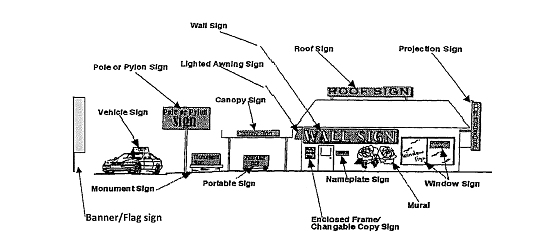
Sign area. Calculation means the area of the sign to be computed by drawing a line or lines around the sign in such a way as to form a rectangle oriented horizontally. The sum square footage of these figures shall be considered as the total area of the sign face. A sign face may be single-sided or double-sided, as with a typical pole sign; however, to calculate the area of a multi-sided sign, the sum of all sides of the sign shall not exceed twice the area specified for the sign face.
Sign box. The rectangle used to calculate the sign area.
Snipe sign. A sign made of any material when the sign is tacked, nailed, posted, pasted, glued or otherwise attached to trees, poles, fences or other objects, and the advertising matter appearing thereon is not applicable to the use of the premises upon which the sign is located.
Temporary sign. Any sign constructed of cloth, canvas, plastic, light fabric, wallboard, or other material, with or without frames, intended to be displayed for a period of time not to exceed 30 consecutive days during a 90-day period.
Undeveloped property. A tract of land upon which no structure is located.
Vehicular sign. Any sign attached to a trailer, skid or similar mobile structure, where the primary use of the structure is to provide a base for the sign or constitute the sign itself.
Vertical banner. Any sign of a lightweight fabric or similar material that is mounted to a pole in a vertical fashion, secured at the top and bottom of the banner.
Wall area. The area of the wall from the finished floor elevation (or top of foundation) to the top of the parapet wall or to the bottom of the eave, whichever is highest. This wall area is as shown on the architectural elevation of the wall, including glass area and recessed wall areas.
Wall area, multi-story building. The sign wall area calculation for multi-story buildings shall be based upon the height of the first story (including any mezzanine level).
Wall, primary. The wall determined to be the primary signage wall, subject to its incorporating either the major entrance or the common street address.
Wall, secondary. The wall of a building is determined to be of secondary importance to the single business or establishment occupying the premises, and only facing onto a street, right-of-way or parking lot.
Wall sign.
- A sign which is attached or affixed to the wall of a building, or is an integral part of the wall of a building, with the exposed face of the sign in a plane parallel to and not extending more than 12 inches from the wall. A wall sign shall not extend above the wall/parapet to which the sign is attached.
- For the purpose of this section, awnings, canopy fascias and mansards extending along a building side shall be considered a part of the wall. The roof (including mansard and fake mansard roofs) and roof area are not included in the wall area.
Window sign. A permanent sign or mural attached to, placed upon, or painted on the window or door of a building which is intended for public viewing from the exterior of the building requires a permit approved by the Building Official Office. This permit will have no fee.
- Temporary window signs being used to advertise an event that do not exceed 11” x 14,” and are not permanently affixed to the window do not require a permit.
(Ordinance 299-C adopted 1/13/04; Ordinance 525 adopted 12/9/13; 2007 Code, sec. 153.08; Ordinance 2020.10.12A, sec. 2, adopted 10/12/20)
- Any person, firm, corporation or agent who violates any of the provisions of this article shall be guilty of a misdemeanor and, upon conviction thereof in municipal court, shall be fined an amount not less than $25.00 nor more than $200.00. Each day that a violation is permitted to exist shall constitute a separate offense.
- The judge of the municipal court may order the violation to be abated within a reasonable length of time, not to exceed 30 days.
- If the owner or the occupant of the premises fails and refuses to comply with the order to abate the violation, the code enforcement officer may enter upon the property and remove the sign from the premises.
- The property owner or occupant shall be billed for the cost of sign removal. Failure to reimburse the city for costs of removing damaged signs shall result in the filing of a lien against the property to secure payment thereof.
(Ordinance 299-C adopted 1/13/04; Ordinance 525 adopted 12/9/13; 2007 Code, sec. 153.99)
Editor’s note–Former section 3.10.003 pertaining to the objectives was repealed and deleted in its entirety by Ordinance 2020.10.12A, sec. 3, adopted 10/12/20. Prior to the deletion, this section derived from the following: Ordinance 299-C adopted 1/13/04l; Ordinance 525 adopted 12/9/13 and the 2007 Code, sec. 153.99
- Permit required. No person or business firm shall erect any sign or sign structure until a sign permit for the work has been issued by the Building Official Office to a contractor or the owner or occupant of the premises where the work is to be done.
- Temporary Signs in B-3, B-2, B-1, on the downtown square, and immediately surrounding the Historical Overlay District must have a permit for any temporary signs. There will be no permit fee for these requests.
- Contents of sign. All signs shall pertain only to the identification of the occupant/business/name, primary uses and/or services provided or primary products sold on the premises, except for government or community service signs as provided.
- Compliance with other regulations. All signs shall meet the requirements of all applicable codes and ordinances pertaining to sign construction of the city. All signs located on state or federal highways shall conform to state and federal regulations.
- Alteration of message. Except as herein provided, no person or business firm, acting either as principal or agent, shall alter the copy face or lettering of any sign (except for signs with temporary messages made from interchangeable characters attached to tracks or grooves on the sign board), either by changing the message or by renovating an existing message.
- Reserved.
- Projecting over property line. No sign, sign structure or sign support shall project over any property line.
- Prohibited supports. Trees, rocks, bridges, fences, utility poles, windmill towers and dilapidated buildings shall not be used as sign supports.
- Street address signs. All building locations shall be identified by a street address sign that is clearly visible from the street.
- Flashing, blinking or traveling lights. All these signs must comply with state regulations. The maximum brightness of signs with flashing, blinking or traveling lights shall not exceed .3 (three tenths) footcandles over ambient light levels when measured according to the following procedures. The illuminance of an EMC shall be measured with an illuminance meter set to measure footcandles accurate to at least two decimals. Illuminance shall be measured with the EMC off, and again with the EMC displaying a white image for a full color capable EMC, or a solid message for a single-color EMC. All measurements shall be taken perpendicular to the face of the EMC in keeping with the distance requirements of the following table. Certification of the calibration must be presented to the city at the time of the initial installation. On an annual basis, the city may require certification that the unit has been calibrated to conform to the requirements of this section.
Note: For signs of other sizes than those listed above the following formula may be used to calculate the distance required: Distance - Square root of (the area of the sign X 100).Area of Sign (sq. ft.) Distance Required (ft.) Area of Sign (sq. ft.) Distance Required (ft.) 10 32 85 92 15 39 90 95 20 45 95 97 25 50 100 100 30 55 110 105 35 59 120 110 40 63 130 114 45 67 140 118 50 71 150 122 55 74 160 126 60 77 170 130 65 81 180 134 70 84 190 138 75 87 200 141 80 89 - Attachment of portable signs. In the event a portable sign is used as a freestanding sign in the R-3, B-1, B-2, B-3 or I districts, the sign shall be securely attached to the ground to prevent movement by wind or other means.
- Flags. Flags of any nation, state or political subdivision or one flag which shows an emblem or logo of a firm or corporation will be permitted, provided all other regulations are met. Businesses may have up to 3 permanent flagpoles on their property. Flagpoles shall not be higher than 35 feet in height, as measured from the ground at the base of the pole to the top.
- Digital sign standards.
- The display or message may not change more frequently than once every eight seconds, with a transition period of one second or less.
- No flashing, dimming or brightening of message is permitted except to accommodate changes of message.
- An ambient light monitor shall be installed which shall continuously monitor and automatically adjust the brightness level of the display based on ambient light conditions and the brightness levels allowed under this article.
- The maximum brightness shall comply with the standards set forth in subsection (i) above.
(Ordinance 299-C adopted 1/13/04; Ordinance 525 adopted 12/9/13; 2007 Code, sec. 153.02; Ordinance 2020.10.12A, sec. 4, adopted 10/12/20)
- Construction materials; design approval. Monument signs and pole signs will have base planters constructed of rock, stone or masonry products. Design approval must be obtained from the building official prior to construction. Monument signs may not exceed 6 feet in height. Pole construction will be used for signs higher than six feet.
- Signs in the historic district. Signs in the historic district are exempted from the requirements of this section. Design and construction standards for signs in the historic district shall comply with section 3.10.047 of this article.
(Ordinance 299-C adopted 1/13/04; Ordinance 525 adopted 12/9/13; 2007 Code, sec. 153.03; Ordinance 2020.10.12A, sec. 5, adopted 10/12/20)
Landscaping must be provided for all new freestanding signs. Landscape design approval must be obtained from the building official prior to installation. (Ordinance 299-C adopted 1/13/04; Ordinance 525 adopted 12/9/13; 2007 Code, sec. 153.04; Ordinance 2020.03.17D, sec. 4(a), adopted 3/17/20)
The following signs shall be prohibited in all districts:
- Any signs and supports, other than those required by a governmental authority, that are located on the public right-of-way, including public streets, alleys, and parkways. This section shall not apply to signs on commercial vehicles or commercial trailers lawfully operated or parked in those areas, except that this exception shall not otherwise be used to legitimize the use of advertising vehicles and trailers prohibited in section 3.10.008. Any sign and supports located on the public right-of-way or easements, including public streets, alleys, and parkways, may be immediately removed by the code enforcement officer or other authorized city employee without notice.
- Twirling signs, digital signs (motion), sidewalk or curb signs, and pole signs;
- Signs which, by reason of their size, location, movement, content, coloring, or manner of illumination, may be confused with or construed as a traffic-control sign, signal or device, or the light of an emergency or road equipment vehicle, or which hide from view any traffic or street sign, signal or device;
- Any sign which emits sound or odor that is offensive in nature or visible in a manner that serves as a distraction to persons within the public right-of-way; and
- Abandoned and/or damaged signs are prohibited and shall be removed by the property owner. Notice of a violation shall be issued by the code enforcement officer or other designated city representative in accordance with the notice requirements in section 3.10.112.
No person shall park a vehicle or trailer outfitted for advertising, other than side-door panel business advertising, on a public right-of-way. (Ordinance 299-C adopted 1/13/04; Ordinance 525 adopted 12/9/13; 2007 Code, sec. 153.06)
Any sign already in place at the time this article is adopted will be exempt from these regulations until the time that the sign falls into disrepair, is destroyed, is remodeled by as much as 50%, or is replaced. In this context, remodeling shall not include approved repainting or resurfacing. At the time the sign is replaced, the replacement sign must conform to these regulations. (Ordinance 299-C adopted 1/13/04; Ordinance 525 adopted 12/9/13; 2007 Code, sec. 153.07)
3.10.042 R-2m, R-3 And R-4 Districts
3.10.043 B-1, B-2, B-3 And I Districts
3.10.044 (Reserved)
3.10.045 (Reserved)
3.10.046 (Reserved)
3.10.047 Historic District
3.10.048 Table Of Requirements For Permanent Signs
3.10.049 Somervell County Hospital District Signage
The following regulations shall apply in the R-1 and R-2 districts:
- Sign identifying occupant. One unlighted sign, which shall not exceed one square foot in area, indicating the name of the occupant, shall be permitted, provided the sign is attached to the face of the wall, with no open space between the sign and the wall;
- Churches and schools. One sign, which shall not exceed 18 square feet, for a church or school shall be permitted;
- Lease, sale or rental sign. One unlighted sign, which shall not exceed 10 square feet in area, on each lot, pertaining to the prospective lease, sale or rental of the building or premises on which it is located, provided the sign is immediately removed upon the lease, sale or rental of the building or premises;
- Primary uses. Signs shall be specifically described and indicated on the site plan. The sign requirement for each use shall not be less restrictive than those of the respective district in which the use is otherwise permitted; and
- Accommodations facilities. In the event a special use permit is granted by council for the operation of an accommodations facility within an R-1 district, the following restrictions shall apply:
- One sign shall be permitted per establishment, not to exceed 16 square feet in size, inclusive of the support structure;
- The vertical dimension shall be considered to be the height of the support structure or the height of the sign, whichever is greater, and in no case shall exceed 4 feet;
- The horizontal dimension shall be considered to be the width of the support structure or the width of the sign, whichever is greater, and in no case shall exceed 4 feet;
- The sign may be either a freestanding or shingle-type sign;
- The sign may be situated between the structure and the street; and
- All signs shall be approved by the city building official or code enforcement officer prior to installation.
(Ordinance 299-C adopted 1/13/04; Ordinance 525 adopted 12/9/13; 2007 Code, sec. 153.20)
The following regulations shall apply in the [R-2m,] R-3 and R-4 districts:
- General requirements. [R-2m,] R-3 and R-4 uses shall meet the requirements of their respective districts as outlined in sections 3.10.004 through 3.10.007;
- Primary identification signs. Primary identification signs, each having an area not exceeding 10% of the area of one wall or 5% of the area of 2 walls, where applicable, or 50 square feet, whichever is less;
- Development name. One freestanding monument sign identifying the name of the development shall be permitted. This sign area shall not exceed 50 square feet per side. Overall sign height shall not exceed 6 feet. Sign setbacks shall be a minimum of 10 feet from the property line;
- Informational signs. Informational-type signs, each not exceeding 10 square feet in area per building;
- Placement. All signs shall be placed flat against the wall of a building and shall not extend above the front wall or side wall of the building;
- Lighting and identification. All signs, except for the informational signs, shall identify the development by name and address only. Signs may be back-lighted, lighted indirectly, lighted internally or lighted by spotlights; and
- Primary uses. Signs shall be specifically described and indicated on the site plan. The sign requirement for each use shall not be less restrictive than those of the respective district in which the use is otherwise first permitted.
(Ordinance 299-C adopted 1/13/04; Ordinance 525 adopted 12/9/13; 2007 Code, sec. 153.21; Ordinance adopting 2017 Code; Ordinance 2020.10.12A, sec. 6, adopted 10/12/20)
The following regulations shall apply in the B-1, [B-2, B-3 and I] districts:
- Auxiliary signs. Auxiliary signs not exceeding 10 square feet in total area per building may be placed in a window or flat against the wall of a building. Freestanding auxiliary signs of not more than 2-1/2 feet in height and 3 square feet in area are permitted on private property if limited to traffic direction or parking direction. Auxiliary sign area shall not be counted against total permitted sign area;
- Service station canopy signs.
- Service station canopy signs shall be counted as a part of and limited to the percentage allowable for wall signs. Canopy signs may not exceed 20 feet in height and shall not exceed the top of the canopy on any side;
- Signs may be attached to and suspended from the underside of building canopies, with the following restrictions:
- No more than one such sign is permitted per business;
- The sign must identify only the store’s name and address;
- The bottom edge of the sign shall be no less than 7 feet above grade; and
- The sign may be placed perpendicular to the front wall of the building;
- Signs may be located any place on a canopy that is not attached to a building, except that the signs shall not project beyond the width or height of that canopy, nor more than one foot below that canopy;
- Freestanding signs. One freestanding monument sign for each freestanding building in the B-1 district shall be permitted, meeting the following requirements:
- Area. The area of the sign shall not exceed an amount equal to 0.40 square feet per front foot of the lot. The sign area shall not exceed 80 square feet per side;
- Height. Sign height shall not exceed 6 feet, except signs may increase in height 1 foot for every extra 1 foot beyond the required setback to a height not to exceed 15 feet, except along either side of Highway 67, in which case the maximum height shall be 25 feet; and
- Setback. Sign setbacks shall be a minimum of 10 feet from the property line, as long as it does not interfere with the visibility of neighboring building signage. Where neighboring structures or vegetative growth are close to the property line, permission by the building official, or his designee, may be given to place a sign closer to the property line.
- Wall signs. Advertising signs, when the same are attached to a building and advertise only the business name, services, articles or products offered within the building to which the sign is attached, shall be permitted, provided that the signs shall not extend more than 3 feet vertically above the outside walls of the buildings, nor more than 2 feet perpendicular from the face of the walls of the building. Not more than 10% of any wall shall be used for these signs, except, when freestanding signs are allowed but not used, this may be increased to not more than 15% of the wall; and
- Primary uses. Signs shall be specifically described and indicated on the site plan. The sign requirement for each use shall not be less restrictive than those of the respective district in which the use is otherwise first permitted.
- Signs on the Historic Courthouse Square must be approved by the Historic Preservation Commission (HPC) before a permit may be obtained.
(Ordinance 299-C adopted 1/13/04; Ordinance 525 adopted 12/9/13; 2007 Code, sec. 153.22; Ordinance adopting 2017 Code; Ordinance 2020.10.12A, sec. 7, adopted 10/12/20)
Editor’s note–Former section 3.10.044 pertaining to the B-2 district, was repealed and deleted in its entirety by Ordinance 2020.10.12A, sec. 8, adopted 10/12/20. Prior to the deletion, this section derived from the following: Ordinance 299-C adopted 1/13/04; Ordinance 525 adopted 12/9/13; 2007 Code, sec. 153.23; Ordinance adopting 2017 Code.
Editor’s note–Former section 3.10.045 pertaining to the B-3 district, was repealed and deleted in its entirety by Ordinance 2020.10.12A, sec. 9, adopted 10/12/20. Prior to the deletion, this section derived from the following: Ordinance 299-C adopted 1/13/04; Ordinance 525 adopted 12/9/13; 2007 Code, sec. 153.24.
Editor’s note–Former section 3.10.046 pertaining to the I district, was repealed and deleted in its entirety by Ordinance 2020.10.12A, sec. 10, adopted 10/12/20. Prior to the deletion, this section derived from the following: Ordinance 299-C adopted 1/13/04; Ordinance 525 adopted 12/9/13; 2007 Code, sec. 153.25; Ordinance adopting 2017 Code.
In addition to any requirements of this article, all signage within any historic district must also meet the requirements and/or restrictions specified in the governing guidelines of the historic district and the construction materials and design standards for those signs must be approved by the historic preservation commission prior to construction. (Ordinance 525 adopted 12/9/13; 2007 Code, sec. 153.26; Ordinance 2020.10.12A, sec. 11, adopted 10/12/20)
PERMANENT SIGNS
All signs must be permitted through the code enforcement officer.
| District | Per Unit | Type of Sign Permitted | Maximum Area | Maximum Height | Requirements |
| Residential | |||||
| R-1 and R-2 Residential | 1 | Wall sign only | 1 sq. ft. | Must contain only occupant’s name. Must be secured to wall with no open space between sign and wall. | |
| Church or school | 1 | Church or school | 18 sq. ft. | One sign allowed for each church or school | |
| Accommodations facility in R-1 | 1 | Freestanding or shingle | 16 sq. ft. | 4 ft. overall | Facility requires special use permit. Sign must be located between structure and street. |
| R-3 and R-4 Residential | 1 | Freestanding | 80 sq. ft. | 6 ft. | Allowed only to identify name of development. |
| Commercial | |||||
| B-1 Restricted B-2 General B-3 Central Business District | N/A | Auxiliary signs, wall or window | 10 sq. ft. or 10% of total area of wall | Must be placed in window or flat against exterior wall. | |
| N/A | Freestanding auxiliary signs | 3 sq. ft. | 30 inches | Permitted on private property if limited to traffic or parking directions. Not counted against total sign area. | |
| B-1=1 B-2=2 B-3=1 | Freestanding monument sign | 80 sq. ft. | 6 ft. plus an additional 1 ft. for every additional 1 ft. of setback. 15' except max. 25' on Hwy 67 | Mandatory 10-ft. setback from property line. Allowed only for freestanding buildings. | |
| N/A | Wall sign | Maximum 10% of wall area, 15% if freestanding | Maximum extend 3 ft. vertical or 3 ft. perpendicular | Must be attached to building and advertise only the name, services, articles or products offered within the building. | |
| Industrial | 1 | Service station canopy sign | 4 sq. ft. | Must be 7 ft. above grade Must be 20 ft. high | Shall be counted as a part of the percentage allowable for wall signs. Shall not exceed the canopy on any side. Must identify only the name of store and address. May be perpendicular to front wall. Allowed any place on freestanding canopy, but cannot exceed height or protrude more than 1 foot below canopy. May be suspended from underside. |
| N/A | Auxiliary signs, wall or window | 10 sq. ft. | Must be placed in window or flat against exterior wall. | ||
| N/A | Freestanding auxiliary | 3 sq. ft. | 30 inches | Permitted on private property if limited to traffic or parking directions. Not counted against total sign area. | |
| N/A | Wall sign | Maximum 10% of wall area, 15% if freestanding | Maximum extend 3 ft. vertical or 2 ft. perpendicular | Must be attached to building and advertise only the name, services, articles or products offered within the building. |
(Ordinance 525 adopted 12/9/13; 2007 Code, ch. 153, app. A; Ordinance 2020.10.12A, sec. 12, adopted 10/12/20)
Notwithstanding other provisions within the city’s code to the contrary, a freestanding monument sign for the Somervell County Hospital District facilities shall be deemed acceptable provided it conforms to the following requirements:
- It shall not exceed twenty-six feet (26') in height;
- The overall area of the sign, including the base, shall not exceed two hundred and seventy-five (275) square feet per side;
- The sign shall be located on the SCHD premises and may be located immediately adjacent to the Highway 67 right-of-way, provided it does not encroach upon the thirty foot by thirty foot (30' X 30') field of view triangle at the intersection of the facility’s driveway and Highway 67;
- The sign may have internal illumination, provided the light is not of such intensity or brilliance to cause glare or otherwise impair the vision of a passing motorist, or result in a nuisance to said motorist;
- The base shall be constructed of rock, stone, or other masonry products;
- The sign’s foundation shall be designed to withstand anticipated wind loads and the drawings shall be sealed by a state licensed professional engineer; and
- Should the sign be located or encroach upon TxDOT right-of-way, that agency will need to be consulted and its standards adhered to.
(Ordinance 2019.11.11C adopted 11/11/19)
3.10.082 Governmental Signs
3.10.083 Temporary Business Promotional Signs
3.10.084 Community Service Signs
3.10.085 Monument Signs
3.10.086 Wayfinding Signs
On property of one acre or more, for-sale signs, rental signs or temporary construction site signs not exceeding 32 square feet in area and 6 feet in height may be placed at a development site. On property of less than an acre, the aforementioned signs may not exceed 6 square feet in area and 4 feet in height. These signs are not subject to permit fees. (Ordinance 299-C adopted 1/13/04; Ordinance 525 adopted 12/9/13; 2007 Code, sec. 153.35; Ordinance 2020.10.12A, sec. 13, adopted 10/12/20)
Governmental signs not exceeding 32 square feet in area and not exceeding 10 feet in height shall be permitted. This standard shall not apply where state or federal regulations are in conflict with these standards. (Ordinance 299-C adopted 1/13/04; Ordinance 525 adopted 12/9/13; 2007 Code, sec. 153.36)
- Any temporary business promotional signs shall only be placed in or on windows and shall have a combined area not exceeding 10% of the area of all windows on the same wall. Area of the signs shall not be counted against total permitted sign area and no permit is required.
- A-frame or sandwich signs. “A-frame” or “sandwich” signs shall be permitted, provided they meet the following criteria:
- Sign approval must be obtained from the code enforcement officer prior to use;
- The sign must be no larger than 4 feet high by 2 feet wide;
- The sign must be professional in appearance (painting, lettering and the like);
- The sign must be located in front of the business it advertises. If located elsewhere, the sign owner must provide written permission from the owner of the property where the sign is located;
- The sign may only be placed on the sidewalk during business hours;
- The sign may not block the sidewalk or interfere with walking traffic; and
- The sign may not interfere with Americans with Disabilities Act guidelines.
- These signs are not subject to a time limit.
- Banners, pennants and portable signs. Banners, pennants and portable signs are authorized in all nonresidential districts, subject to the following restrictions:
- A temporary sign authorization must be approved by the city prior to erecting or placing the sign. Authorizations for temporary signs shall be granted only with the written consent of the owner or person in charge of the property.
- The total square footage of all temporary signs placed by one authorization shall not exceed 75 square feet.
- A total of 5 temporary signs shall be authorized by any one authorization, per business, as long as the total square footage of these signs does not exceed 75 square feet.
- The maximum permitted height per sign is 6 feet, except vertical, flag-type banners may have a maximum height of 12 feet.
- No fees will apply for temporary/portable signs.
- Signs must be kept in a serviceable condition at all times. A tear over 5 inches in length, a sign coming loose from its stand or frame, letters missing from a sign, or materials faded 50% or more are considered unserviceable, and must be removed.
- Temporary sign authorizations are good for a period of 12 months. If the authorized sign is replaced, using another sign the same exact size, a new authorization is not required during the 12-month period.
- Portable temporary signs with changeable letters that are not being utilized must be removed from public view.
- Inflatable signs and balloons. Inflatable signs are permitted in nonresidential zoning districts, subject to the following:
- Inflatable signs shall not exceed 20 feet in height or 10 feet in width, and shall be fastened securely to the level ground. No balloon shall be flown at a height exceeding 100 feet above the level ground.
- No inflatable sign shall be attached to the roof of a building or other structure.
- An inflatable sign authorization is valid for 14 days. No more than 4 inflatable sign authorizations shall be issued per calendar year for any one business or property.
- No inflatable sign shall be located within 20 feet of a roadway or a driveway or other ingress or egress from the property.
- A no-fee permit is required for inflatable signs and balloons.
(Ordinance 299-C adopted 1/13/04; Ordinance 374 adopted 4/27/04; Ordinance 525 adopted 12/9/13; 2007 Code, sec. 153.37; Ordinance 2020.10.12A, sec. 14, adopted 10/12/20)
Community service signs for seasonal celebrations shall have no size limitation if placed in or on windows and have a combined area not exceeding 10% of the area of all the windows on that same wall. Stake-type community service signs that are not of a seasonal celebration nature, that support programs or functions sanctioned by the school district or other nonprofit organizations, shall be permitted, provided they are not larger than 18 inches by 24 inches, are not placed on the right-of-way and are not an obstruction for traffic. A permit shall be required for any sign larger than 18 inches by 24 inches. (Ordinance 299-C adopted 1/13/04; Ordinance 525 adopted 12/9/13; 2007 Code, sec. 153.38)
- Nonresidential districts. Monument signs in nonresidential districts are subject to the following restrictions:
- No more than one monument sign shall be permitted for every 300 feet of street frontage on each premises, except that a lot that has frontage on more than one street may have one sign on each street on which the property fronts. Only one monument sign shall be erected along the same street frontage.
- A monument sign may be illuminated internally, or by an external light source if that light source cannot be seen from the public right-of-way. An electronic or message board is permitted if it does not occupy more than 24 square feet of the area of the sign face.
- The sign base and sign shall be covered or constructed with the same masonry materials, stone, or brick as the principal building, or with other materials approved by the code enforcement officer. All materials used must complement the architecture of the principal building.
- Residential districts. Monument signs are allowed in single-family residential districts for the purpose of identifying a residential subdivision or for nonresidential uses that are permitted in such district. Monument signs shall be subject to the following restrictions:
- No more than one monument sign shall be permitted for every 300 feet of street frontage on each premises, except that a lot that has a frontage on more than one street may have one sign for each street on which the property fronts.
- A monument sign shall not exceed 4 feet in height, plus a maximum of 2 feet at the sign base.
- A monument sign shall not exceed one square foot of gross surface area for every 2 feet of street frontage, or a maximum of 50 square feet.
- A monument sign may be illuminated by an external light source if that light source cannot be seen from the public right-of-way.
- The sign base and sign shall be covered or constructed with the same masonry materials, stone, or brick as the principal buildings, or with other materials approved by the code enforcement officer. All materials used must complement the architecture of the principal building.
(Ordinance 525 adopted 12/9/13; 2007 Code, sec. 153.39; Ordinance 2020.10.12A, sec. 15, adopted 10/12/20)
Wayfinding signs (kiosks) may be installed if recommended by the planning and zoning commission and approved by the city council. Planning and zoning commission recommendations for wayfinding signage in the historic district shall be reviewed and approved by the historic preservation commission prior to the recommendation being forwarded to the city council for final approval. (Ordinance 2020.10.12A, sec. 16, adopted 10/12/20)
3.10.112 Notice Of Noncompliance
3.10.113 Dimensional Variances
Permit fees shall be as set forth in the fee schedule in appendix A of this code. (Ordinance 299-C adopted 1/13/04; Ordinance 525 adopted 12/9/13; 2007 Code, sec. 153.50; Ordinance adopting 2017 Code)
It shall be the duty of the code enforcement officer or his or her representative, upon having personal knowledge of a violation of this article, to serve written notice to the owner or lessee of the property upon which the sign is located, either by hand delivering in person or by depositing a notice of noncompliance in the United States mail, certified mail, return receipt requested. This notice shall state the name of the person to whom the notice is sent or delivered, include a general description of the violation, state the legal address of the property on which the violation has occurred, and state that the owner, lessee or other person having control of the property shall abate the violation and comply with the provisions of this article within 10 days from the date of the notice. (Ordinance 299-C adopted 1/13/04; Ordinance 525 adopted 12/9/13; 2007 Code, sec. 153.51)
Where adherence to the dimensional standards established in this article creates practical difficulties and/or is unnecessarily burdensome due to features unique to a property or group of properties, the property owner or lessee shall be granted an opportunity to state his or her case before the board of adjustments. If the board of adjustments determines such would provide substantial justice to the owner, it may agree to waive or modify those dimensional standards. The decision of the board of adjustments shall be final. (Ordinance 2020.10.12A, sec. 17, adopted 10/12/20)
3.10.142 Penalty
3.10.143 General Provisions; Prohibited Billboards
3.10.144 Abandoned Or Damaged Billboards
3.10.145 Nonconforming Billboards
3.10.146 Notice Of Noncompliance
Editor's note–Former section 3.10.147 pertaining to the financial hardship provision, was repealed and deleted in its entirety by Ordinance 2020.10.12A, sec. 19, adopted 10/12/20. Prior to the deletion, this section derived from the following: Ordinance 268 adopted 10/8/96; 2007 Code, sec. 150.17(G).
For the purpose of this division, the following definition shall apply, unless the context clearly indicates or requires a different meaning.
Billboard. An offsite sign or any other advertising device with a total sign face exceeding 400 square feet of sign face or with a support or supports greater than 2 square feet in cross-section or an overall height which exceeds 20 vertical feet from the ground upon which it sits, or, in the case of a sign or device installed on a higher elevation, the “ground” shall be measured from the crown of the road from which any face of the sign is visible.
(Ordinance 268 adopted 10/8/96; 2007 Code, sec. 150.17(A); Ordinance 2020.10.12A, sec. 18, adopted 10/12/20)
Any person, firm, corporation or agent who violates any of the provisions of this division shall be guilty of a misdemeanor, and upon conviction thereof shall be fined an amount not less than $25.00 nor more than $200.00. Each day that a violation is permitted to exist shall constitute a separate offense. (Ordinance 268 adopted 10/8/96; 2007 Code, sec. 150.99(D))
- Prohibited billboards. All billboards are hereby prohibited except as set forth herein.
- Existing billboards.
- All existing billboards shall meet the requirements of all applicable codes and ordinances pertaining to billboard construction of the city.
- All existing billboards located on state or federal highways shall conform to state and federal regulations.
- Permit required; altering message. Except as herein provided, no person or business firm, acting as principal or agent, shall alter the copy face or lettering of any billboard, except for billboards with temporary messages made from interchangeable characters attached to tracks or grooves on the billboard, either by changing the message or by renovating an existing message, or shall erect any billboard or billboard structure until a billboard permit for the work has been issued by the city building official or designee to a contractor or the owner or occupant of the premises where the work is to be done.
- Sign faces. No more than 2 sides of a billboard structure may be used for display.
- Projecting over property line. No billboard, billboard structure or billboard support shall project over any property line.
- Prohibited supports. Trees, loose rocks, bridges, fences, windmill towers and dilapidated buildings shall not be used as billboard supports.
- Street address sign. All building locations shall be identified by a street address sign which is clearly visible from the street in letters not less than 2 inches tall.
- Flashing, blinking or traveling lights. No billboards with flashing, blinking or traveling lights shall be allowed, nor shall any billboard have any moving parts as a part of the visible signage.
- Conflicting regulations. In the event that more than one billboard-related definition applies to a non-prohibited proposed sign, resulting in conflicting regulations thereon, the billboard applicant may choose the definition that is to apply, with the qualification that any regulations related to that definition must be adopted. Where the proposed sign is of a type that is prohibited, it shall remain prohibited notwithstanding that it may also come within the definition of an approved type of billboard.
(Ordinance 268 adopted 10/8/96; 2007 Code, sec. 150.17(B); Ordinance adopting 2017 Code)
- All abandoned billboards and their supports shall be removed within 30 days from the date of abandonment. All damaged billboards shall be repaired or removed within 30 days. The building official or designee shall have the authority to grant a time extension not to exceed an additional 30 days for an abandoned, undamaged billboard.
- Should the responsible party or parties, after due notice, fail to correct a violation of this section, the building official or designee shall cause the signs and their supports to be demolished and removed. If the billboard cannot be demolished because it is painted on a building or other non-sign structure, the sign shall be painted over or removed by sandblasting. The building official or designee shall also file against the property a lien in the amount of the cost of all the work.
(Ordinance 268 adopted 10/8/96; 2007 Code, sec. 150.17(D); Ordinance adopting 2017 Code)
All billboards which do not conform to the provisions of this division and are in existence on the effective date of this division shall be permitted to remain for a time period not exceeding 10 years from the effective date of this division, provided the owners of nonconforming billboards shall register the billboard in writing in the office of the building official or designee within 180 days after passage of these regulations. (Ordinance 268 adopted 10/8/96; 2007 Code, sec. 150.17(E); Ordinance adopting 2017 Code)
It shall be the right of the code enforcement officer or his or her representative, upon having personal knowledge of the violation of this division, to serve written notice to the owner/lessee either by hand delivering in person or by depositing notice in the United States mail (certified mail, return receipt requested). This notice shall state the nature of the violation, the legal address of the property in violation, and the name of the person to whom the notice is sent or delivered. Upon being served the notice, the owner or lessee or any other person having control of the property shall have 10 days from the date of notification to bring the property into compliance with the provisions of this division. (Ordinance 268 adopted 10/8/96; 2007 Code, sec. 150.17(F))